Base Coat Gel and Top Coat Gel are essential parts of a gel polish system, but they perform different functions. Base Coat Gel is applied before Color Gel to support adhesion and prepare the nail surface. Top Coat Gel is applied after the color layer to create the final finish and help protect the manicure.
For nail brand buyers, wholesalers, and distributors, these products should be evaluated as a compatible system rather than selected only by price or packaging.
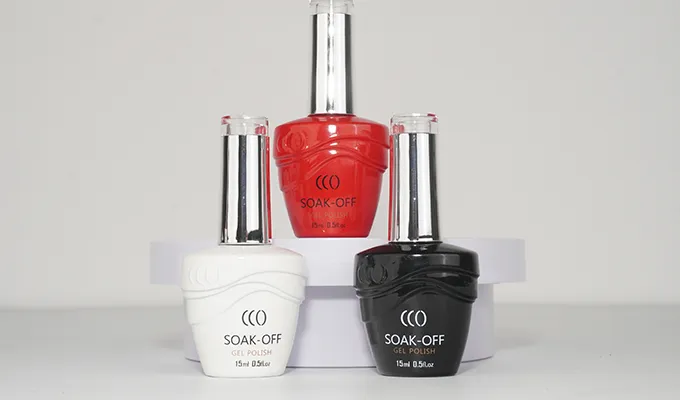
Base Coat Gel forms the first cured layer. Depending on the formula, it may support adhesion, limited leveling, or flexibility.Top Coat Gel forms the final surface. It may create a glossy, matte, or other finish. Some formulas leave an inhibition layer that must be wiped after curing, while No Wipe Top Coat Gel is designed to finish without that step.Buyers can review the current range through the CCO Gel Polish product page and visit the CCO Nail Gel website for general brand information.
| Comparison | Base Coat Gel | Top Coat Gel |
|---|---|---|
| Application order | Before Color Gel | After Color Gel |
| Main purpose | Supports adhesion and prepares the surface | Creates the final finish and protects the color |
| Main risks | Lifting, shrinkage, weak adhesion | Yellowing, gloss loss, cracking |
| Compatibility focus | Natural nail, primer, Color Gel | Color Gel, Builder Gel, decorations |
| Bulk-order tests | Adhesion, curing, flexibility, removal | Finish, curing, wear, yellowing |
| Related keyword | gel polish base bulk | gel top coat bulk |
A base coat may have strong adhesion but still perform poorly with an incompatible color formula. A top coat may lose gloss or crack if it is applied too thickly, cured incorrectly, or placed over a very flexible layer. Buyers should therefore test the exact Base Coat Gel, Color Gel, and Top Coat Gel combination intended for sale.
Professional salon brands generally need stable adhesion, efficient curing, and predictable wear. Retail and e-commerce products also need clear instructions covering application order, recommended lamp, curing time, wiping requirements, and removal.Wholesalers purchasing bulk nail polish base or bulk gel top coat should review bottle-neck design, brush width, fill consistency, leakage resistance, batch codes, carton protection, and replenishment lead time.A focused range is often easier to explain and replenish than several products with unclear differences. A brand may begin with one reliable Base Coat Gel and one No Wipe Top Coat Gel before adding matte, high-gloss, or thicker base options.
Base Coat Gel should be tested for adhesion, shrinkage, leveling, curing, flexibility, and soak-off performance.Top Coat Gel should be tested for gloss or matte uniformity, yellowing, staining, cracking, and wear. It should be evaluated over light, dark, and highly pigmented Color Gel. Compatibility with chrome powder, glitter, stickers, or other decorations should be tested separately when relevant.Both products should be tested with UV/LED lamps commonly used in the target market. Recommended layer thickness, lamp specifications, and curing time should be documented.The U.S. FDA states that nail products for home and salon use are generally regulated as cosmetics and must be safe when used according to label directions or customary conditions. Buyers can consult FDA Nail Care Products and the FDA Cosmetics Labeling Guide.For the EU market, responsible persons—and distributors in certain circumstances—must submit required product information through the Cosmetic Products Notification Portal. See the European Commission’s CPNP page.Conclusion: Base Coat Gel and Top Coat Gel should be sourced as connected parts of one gel polish system. Brands should verify compatibility, curing, wear, removal, packaging, and batch consistency before placing a bulk order.
Compatibility should not be assumed. Different formulas may cause lifting, shrinkage, or removal problems.
No. Some formulas leave an inhibition layer, while No Wipe Top Coat Gel does not require wiping after proper curing.
Not necessarily. Each formula may require a different layer thickness and curing time.
Possible causes include insufficient curing, excessive thickness, incompatible layers, abrasion, staining, or formula performance.
Confirm the formula version, capacity, brush, fill tolerance, curing instructions, removal method, labeling, packaging, batch standard, and quantity.

 English